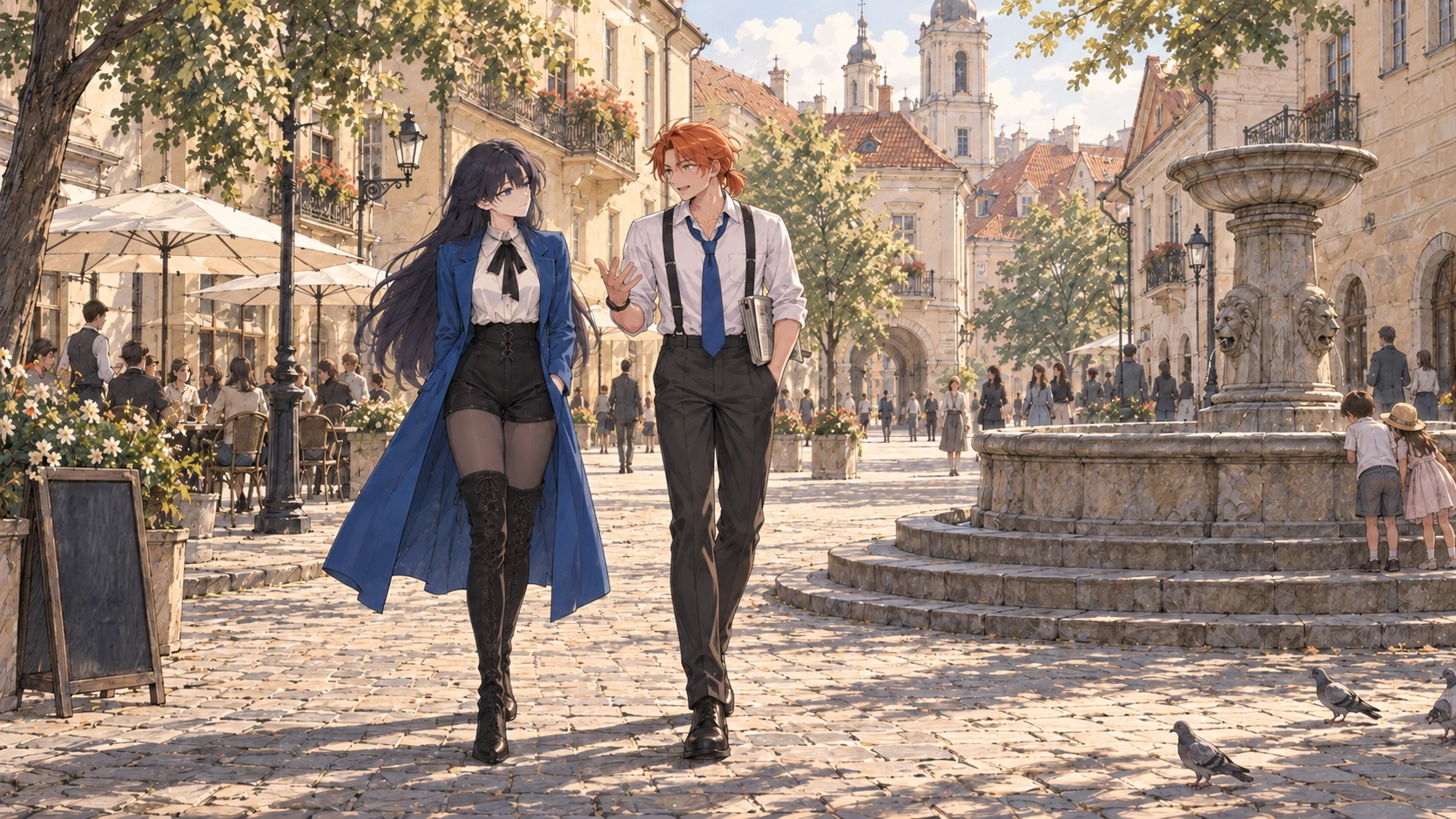
Added 55 seasonal illustrations for Drake, Felix, Kyrien, Sherie and Yulia, plus 11 new pencil sketches. Each character's seasons now have separate Gallery cards, linked inside the reader. Lynleit's spring wave and walking-back-view illustrations have also been updated.
writer's desk
Recent updates ↓
Project MAGIARCHY
Project MAGIARCHY
Writer's desk
Open decisions, the people in play, and a way back into the world.
12 Chapters · 36 Moments · 18 characters
Writer view · includes spoilersA window into the story
Genre & theme balance
Editorial emphasis
What these proportions mean
This is a working editorial balance, not measured screen time or a prescribed story ratio. It groups the existing theme cloud's emphasis weights: primary 3, supporting 2, quieter 1.
- Politics & espionage: Political intrigue, Espionage, Duty (8 points).
- Dread & survival: Horror, Isolation, Survival (7 points).
- Supernatural & mystery: Magic, Mystery (5 points).
- Relationships & desire: Trust, Family, Desire (4 points).
- Identity & inheritance: Identity, Inheritance (3 points).
- Humor & ordinary life: Humor, Ordinary life (2 points).
Back into the world
Lynleit
Walking on water, in secret
Lynleit keeps the talent secret from everyone because the Church strongly punishes miracle-making that imitates acts associated with Jesus, saints, saviours, and other sacred figures, even when the effect seems harmless. She practices alone at night on secluded stretches of local lakes and rivers.
Go to source →Pick up a thread
Open work in the current records.
8 Scene drafts2 Outlines2 Writer gaps
Writer gapsPassages still to write2
Chapter outlinesRecorded events without scene prose2
Open questions 157
0% answered
Kyrien: hidden core
What is the concealed truth, how severe is it, what does Kyrien himself know, and is any Holumn explanation true or merely a possible fear?
Work on this question →Contradictions 0
Contradiction ledger
None recorded
No unresolved contradictions are currently listed.
Review the ledger →Where the cast stands
Who has scenes, and what is driving them?
Scene proseOutline / seedDistinct Moments
18 characters · scroll for the full cast
How to read this
Each current Moment counts once for each listed character. Blue marks a Moment with its own prose or a linked scene Chapter, including incomplete drafts. Grey marks outlines and scene seeds. Linked Chapters are not counted again; standalone Chapters are outside this chart. These are scene-presence counts, not minutes, dialogue shares, or completed-story percentages.
Development shows a recorded goal, profile conflicts, and named links to other cast members. It helps locate thin coverage; it does not score literary complexity, importance, or character quality. Click a character to inspect the evidence. All Arcs are included. Unplaced scenes stay unplaced.
A Holumn to consider
HI-010 · Architectural entrapment and rescue testimony
There Is No Eleventh Floor
An office worker enters an elevator in a ten-floor building and encounters impossible floors, repeated rooms and luring voices. Lynleit brings him back; six minutes have elapsed on the office clock.
Known limits and uncertainties Physical continuity and repeated tests offer temporary guidance. Waiting rather than choosing another route precedes an elevator's appearance. Neither this escape nor the painted boundary is established as universally reliable, and the Holumn is not shown destroyed.
Read the incident →A scene to return to
v3 · Scene draft
There Is No Eleventh Floor
Lynleit rescues an office worker from a building whose floors cannot be counted. His return brings seventeen days in Church custody, not an immediate return to ordinary life.
Placement Early Arc 1, while Fionn is alive
Open the Moment →The story's compass
Direction notes →MagicPolitical intrigueHorrorEspionageIsolationSurvivalIdentityDutyTrustMysteryFamilyInheritanceHumorDesireOrdinary life
Size reflects the established creative emphasis, not a word count or a quota. Open a theme to revisit its guidance.
Recent updates
Latest changes, retained for 31 days.
7 October 2026
The Cloudflare preview is ready, with existing reader links, gallery controls, live notes and continuous music preserved. Published files are available, and the four large WAV downloads match their originals exactly. Connecting the usual domain is the remaining step.
Lynleit has 23 new seasonal illustrations, with one Gallery card for each season. Switch between Spring, Summer, Autumn and Winter inside any of the four entries. These replace her previous seasonal illustrations. Kyrien's beige-jacket reference image has also been updated.
Ten selected images have been removed from the Gallery and panel readers. Remaining versions stay available, and Kyrien’s front reference now uses the updated artwork.
The notes board now fits the available screen width without sideways scrolling. Columns wrap on smaller screens, with sticky headings, direct status jumps and Move controls on every card.
The notes board now shares the Gallery's card styling, with softer borders, clearer titles and compact Move and Open actions. Minimal sticky headings replace the full-height column boxes.
The notes board has compact card previews, full notes on tap, and column headings that stay visible while scrolling the board. Use the Move picker on a phone without dragging. Read-only cards explain how to sign in before moving them.
The notes board brings page notes into six columns. The signed-in owner can drag cards or choose a status. Finished notes leave page sidebars and can be reopened from the board. The top navigation uses its compact menu on tablets too.
4 October 2026
Lynleit’s seasonal wardrobe now includes a spring jacket and three summer views. Two Cat Incident panels have updated character artwork. Seasonal production guidance now includes the magazine-reference requirement.
The panel sequence now has fourteen beats, running from Lynleit and Felix’s walk after lunch to the girl’s smile reflected in Lynleit’s eye.
Lynleit’s shorts always have a belt and never lace-up fastenings. Her profile and character design rules now include this requirement.
Lynleit’s boots are always suede, across every outfit, season and Arc. Her profile and character design rules now specify the material and its matte finish.
Natalia's explanations now have their own collection for future Holumn development, beginning with her words on private terror, shared reality and the cost of continuing a fight.
Read the first explanation3 October 2026
Lynleit's shorts now sit lower at the waist in three Nameless Street beats. Every panel beat uses Gallery-style version thumbnails, showing one selected image with its original download.
View the revised beatsFive canon panel beats follow Lynleit through the empty, fog-bound street, from her first unsteady pause to catching the red balloon.
View the five beatsA new audit covers continuity, character knowledge, prose and visual design. Reviewed face-and-hair corrections are available as v2 artwork, with original images and IDs retained. The report separates confirmed issues from open story decisions and lists any unfinished image corrections. Archived intake sources remain in repository history but are excluded from the website build.
Read the auditTwo views of Lynleit in a blue fur-trimmed cape replace her previous winter coat illustration. Both are grouped in her seasonal wardrobe and available from her profile.
View the winter outfitLynleit's loose hair is waist-length, an exception to the general elbow-length limit. Sherie gathers most of hers in a high bun, leaving a smaller section to the elbow or slightly beyond. Yulia's hair is elbow-length. Their profiles and design guide now record these details.
Read the canon designsFemale long hair must end at or above elbow level, never at the waist. The production guide now requires this check in new image briefs and visual review; existing artwork remains unchanged.
Read the design ruleUpdated Sherie and Felix's Moonlit ace and Moonlit lounge illustrations, including their gallery previews. Gallery filters now stay open and apply immediately, with no extra Show artworks button.
View updated artworkGallery filters now line up in clear groups on desktop and fold into a compact row on phones. See your active selections, reset them together, and close the controls to browse without a filter panel covering the artwork.
Browse the galleryFourteen clothing illustrations for nine characters now sit in seasonal wardrobe stacks. Browse spring, summer, autumn and winter with the new season filter, then switch outfits inside each character's collection.
Browse seasonal outfitsThree new magazine-inspired illustrations join Anima, Lynleit, Sherie and Yulia's non-canon dream collection. Tea-table conversation, moonlit cards and the red sofa each have a new version beside the original.
View the new illustrationsNineteen more chibis now share the earliest Gallery illustrations' bold contours, broad hair shapes and selective shading. Drake, Fionn, Helena, Heyk, Myka, Natalia, Reiner, Tien and Yulia join the refreshed cast, alongside the remaining poses and outfits for Kyrien, Sherie, Felix and Father Mikhail.
View the refreshed collectionTen official chibis for Kyrien, Sherie, Felix, Father Mikhail, Inspector Leo, Hiyu and Ash now use the bold outlines, broad hair shapes and simpler shading of the earliest Gallery illustrations.
View the refreshed chibisCharacter image briefs and finished-art reviews now check the profile proportion tables alongside individual build descriptions and approved references.
Read the design guidanceThe male profile tables now compare shoulder breadth, overall build and muscular bulk alongside height, with the current character highlighted in every row.
Compare proportionsReiner, Fionn, Heyk, Drake, Kyrien, Felix, Tien and Hiyu have clarified builds and a shared height comparison. Kyrien's light frame includes shoulders suited to modelling menswear; Fionn and Heyk stand around his and Felix's height.
Compare the male castLeo and Mikhail's autumn illustrations now pair coloured characters with loosely drawn pencil-and-pen streets and occasional touches of colour.
View the artworkNew canon character illustrations show Inspector Leo on a sunlit autumn street and Father Mikhail walking beneath the old town's lanterns at night.
View the artworkAppearance comparisons now start collapsed and use approximate similarity throughout. Helena and Lynleit share a height of 169 cm.
View Helena's appearanceLynleit, Sherie, Yulia, Natalia, Helena and Myka have updated build descriptions and a compact height and fullness comparison in their profiles. Each table highlights the character being viewed.
Compare appearances1 October 2026
Kyrien recounts the failed watches and boarding; Lynleit tells the struggle beneath the river; Kyrien returns for the water-walking revelation and their way through the quarantined park. Three full-length first-person chapters follow the river and aftermath panels, with the earlier chapter preserved.
Read Part IThe office worker's account now follows the first-person prose standard, with a more natural spoken rhythm and closer attention to his decisions and perceptions. The rescue, Church handoff and earlier version remain intact.
Read the revised ChapterThirteen Fan Service illustrations add poolside Lynleit and Sherie studies, a resort ensemble with Kyrien and Felix, and Sherie and Felix lounge poses. Individual versions and original downloads remain available in each collection.
Browse Fan ServiceFive Lynleit and Sherie illustrations join a shared Fan Service collection, with sleepwear, lace outfits and both cushion-study versions. Updated artwork also appears in the Anima and university-days panels.
Browse the shared studiesA supplied story collection has been analysed for first-person voice, pacing, dialogue and viewpoint. Sixteen mandatory writing and review rules now guide first-person narrative without importing the samples' lore.
Read the analysis and rulesLynleit's two swimwear illustrations have updated artwork. Two black-lace pencil studies of Lynleit and a tailored-outfit pencil study of Sherie join their Fan Service collections.
Browse the artworkThree panels in Anima Meets the Female Cast now use the updated character designs, including Lynleit's Arc 1 face and hair and broader, connected hair shapes.
View the panelsCharacter artwork must use the matching design from the Weapons archive whenever a reference for that weapon type exists.
Read the production guideWhen Lynleit puts on a protective glove for blue flame, she rolls up the corresponding sleeve to keep her clothes from catching fire. Both gloves mean both sleeves.
View her protective glovesFace-and-hair references preserve identity without fixing facial expressions. New artwork should reflect each character's personality and reaction to the scene.
Read the production guideEight references for Drake, Kyrien, Lynleit and Sherie are now available in Production resources, grouped by Arc and normal or fancy treatment. These packages remain the required starting point for new character artwork.
Browse face & hair references30 September 2026
All character artwork now follows a hair-construction rule: cohesive masses with a few broad separations, rather than many thin individual strands.
Read the production guideReference-based image edits must preserve the original head size, head-to-body ratio, body proportions, pose and framing unless a change is requested.
Read the production guideCharacter Image Production now requires dedicated face-and-hair reference packages for new artwork. The selected normal or fancy treatment applies as a whole.
Read the production guideEleven beach, swimwear and satin illustrations of Lynleit, Sherie and Yulia now appear in three Fan Service stacks. Anima's puppeteer composition is available as Beneath the strings in her non-canon panel collection.
Browse Fan ServiceCopyable image IDs are smaller and sit in the bottom-right corner of each image.
Browse the GalleryCopyable IDs now sit in small top-right image overlays, without an extra section beneath the artwork.
Browse the GalleryPublished pictures now have permanent IDs in their filenames and beside their images. Originals use FULL filenames and previews use PREV filenames. Click or tap an ID to copy it when requesting a change.
Browse the GalleryArtwork now has a Fan Service toggle for posed, non-story illustrations, alongside the chibi and pencil/color filters.
Browse Fan ServiceInspector Leo and Father Mikhail now have official pencil portraits and three chibis each, with rotating previews in Characters.
View the artworkA new audit collects 25 source-linked findings on continuity, chronology, character knowledge, prose and unfinished story connections. It separates corrections from author decisions and leaves the story unchanged.
Read the content auditThe Shared Night now keeps Sherie and Felix's no-kissing boundary and leaves Lynleit and Kyrien's dream details open. Fionn's office reprimand follows the early rescue in a new scene outline. Anima's non-canon collection gains another colored study.
Read the revised ChapterA loose sketch of Lester joins the Gallery, showing his crossed-arm pose, cowboy hat and sheathed hatchet.
View the sketch29 September 2026
The story opens in very late summer and develops into warm, bright golden autumn. Writer and image-production guidance now gives this season a major role, especially the contrast between Lynleit's blue clothing and golden-orange landscapes. Later story intervals remain unchanged.
Read the directionFourteen new chibis bring seated poses, movement, laughter and quieter reactions to the cast, including a playful stretch for Ash. Browse each character's variants together in the Gallery; character cards rotate through the new and existing artwork.
Browse the GalleryAn office worker's impossible descent becomes a new Chapter and Holumn incident. Lynleit's protective gloves, the coat's quiet cooperation and the Church handoff connect to her profile and the World archive. Writer guidance also records the new technique-only transcript reference rule.
Read the ChapterGallery, document, character and World readers now share a consistent top inset, keeping notices and page content clear of the header on desktop and mobile.
The Shared Night joins Story with its main events in canon, a linked Moment and Natalia's Oneiric Confluence research. H Scene filters and notices now distinguish depiction, story relevance and canon status across the archive. Exact placement and the Holumn's unresolved limits remain open.
Read The Shared Night28 September 2026
Sherie's personal arc gains a direction of consequence and possible salvation, with Kyrie Eleison (Movement I) available to play and download. Anima Meets the Female Cast joins Panels as a clearly labelled non-canon dream collection.
Read Sherie's arc directionPanel slideshows now share space with a compact scene summary. Sherie's corrected aphorism and her private, deniable intimacy with Felix are reflected in their profiles and writer references.
27 September 2026
The writer's desk now opens with a random scene-panel image and an editorial genre-and-theme chart. Character presence uses larger stacked bars with a shared scale, and Chapter status shows drafts, outlines, and writer gaps at a glance.
Home now opens on the project's working state: open questions, writer gaps, cast coverage, and rotating snapshots of the world, Holumns, and Moments. Questions link to their exact ledger entries. The latest three updates appear below the dashboard, with an option to expand the rest.
Open the writer's deskKyrien and Felix each have three new chibis, grouped by character with outfit thumbnails. Kyrien has his Arc 1 beige jacket and two costume studies in a blue shirt and black coat. Felix wears suspenders, a grey jacket, or carries the jacket over his shoulder. Their character cards choose from these looks on each visit. Chibi labels are easier to read against light backgrounds.
Kyrien's outfits Felix's outfitsHiyu, Yulia and Sherie have simpler, cuter chibis based on their current artwork: Hiyu in his brown coat, Yulia in her white sweater and pendant, and Sherie in her ankle boots.
Browse the charactersAfter the River has a revised final illustration. Music-player buttons no longer retain their dimmed pressed appearance after a tap.
View the final panelThe H Scene toggles are grouped on the right side of the panel filters.
Browse panelsUnresolved Tension follows the revised seven-panel order with updated illustrations. Sherie's sofa entry includes two more images and the ivory-sofa artwork. The two H Scene filters now sit together.
Read the revised panelsSherie's red-sofa studies share one Gallery entry, with separate choices for cards and no cards. Panels now offers optional H Scene filters, and Unresolved Tension has an updated illustration.
View the sofa studiesSherie and Felix's two card-game illustrations now appear only within the complete seven-panel sequence, without duplicate entries in Artwork. Existing image links open the matching panels.
Read Unresolved TensionThree new panel sequences follow Hiyu and Yulia before the Spill, Sherie and Felix over cards, and Lynleit and Kyrien after the river encounter. Yulia also has front and back T-pose references and a birthday necklace whose sender she cannot identify.
Browse scene panels26 September 2026
Sherie reclines with playing cards in a new sofa illustration, and Yulia's revised portrait replaces her earlier white-sweater image. Character name meanings now sit beside the profile descriptions as brief lore notes.
View Sherie's artworkSherie and Felix's relationship direction follows their familiar jokes into harder conversations, divided duties, and the fear of losing one another. Their writing brief includes a recurring musical motif. Other additions include Kyrien and Lynleit's name meanings, Sherie's aphorisms in the author's exact wording, and a park-bank illustration in the Gallery.
Read the relationship directionA new Aphorisms collection opens with two of Sherie's sayings. Yulia has a new portrait, the revised sofa and dinner portraits stand alone, and Sherie and Felix's card-game illustrations are paired artwork in the Gallery.
Read the aphorismsFelix complains about Lynleit over a hand of cards. Sherie has an observation. Read their new Moment and view the two opposing-viewpoint panels in the Gallery.
Read the exchangeHome shows updates from the past 31 days. Older announcements drop out automatically; Chapters, documents, and their previous versions stay available.
Updated portraits of Kyrien and Sherie, Lynleit in the park, and Lynleit at the Prosecutor General's appointment dinner are available in the Gallery. The dinner portrait links to After the Failed Attempt. Hand-detail crops accompany their matching T-pose references, and every artwork has its own search result.
Browse the GalleryBrowse monochrome sketches or colored artwork with the new Pencil only and Colored only toggles. They switch each other off and work alongside the chibi, character, and location filters.
Browse artworkCleared stale repository state that interrupted publishing and documented checks for preserving local work when synchronizing updates.
24 September 2026
The chibi filters now sit together on desktop, with compact, consistent spacing. The mobile layout is unchanged.
The Gallery now lets you exclude chibis as well as show only chibis. Turning either option on switches the other off.
New artwork of Kyrien seated on a red sofa with a pistol is available in the Gallery and his profile artwork.
View Kyrien's portraitLynleit's blue rose gown portrait joins the Gallery and her profile artwork.
View the portraitA rough pen sketch of Sherie seated on a sofa is available in the Gallery and her profile artwork.
View Sherie's sketchA new portrait of Sherie seated on a red sofa is available in the Gallery and her profile artwork.
View Sherie's portraitA pen sketch of Lynleit running across water with blue flame is now available in the Gallery and her profile artwork.
View the sketchNew shared artwork of Hiyu and Yulia is available in the Gallery and on both character profiles.
View Hiyu and YuliaThe earliest cast sketch is now available as two higher-resolution portions, with full-size downloads and links between them.
View the earliest sketchKyrien has new Arc 1 chibi artwork in his beige jacket and blue shirt, now shown on his character card and in the Gallery.
View Kyrien's chibiRemoved retired source files from the backlog archive. Current artwork, story content, and document versions remain available.
23 September 2026
Sleepers above the River now uses the latest panel 2 artwork, including the gallery cover, slideshow, previews, and original download.
View the updated panelThe earliest cast sketch now uses the same masonry column sizing as other artwork, while remaining last in the catalog order.
Lynleit's selected earlier artwork is now labelled Arc 0 in the Gallery and profile portrait viewer. Her Arc 2 artwork is unchanged.
View Arc 0 artworkUpdated panels 1, 2, 3, 8, and 9 in A Meeting Beyond Authority, including their previews and original downloads.
View the panelsA Meeting Beyond Authority now includes the latest edits to panels 7 and 8, with refreshed previews and original downloads.
View the updated panelThe historical artwork is now titled Earliest cast sketch, with a shorter caption.
The earliest cast sketch now sits below all current artwork in the Gallery. It dates from 2021 or earlier, at least five years before its addition to the site.
The earliest cast sketch by Kiril Bekulov, dating to 2021 or earlier, is now in the Gallery as a piece of project history. It has no connection to the current characters, their designs, or story canon.
View historical artworkSeven new sketches follow Kyrien from the riverbank toward the suspended figures, with a slideshow and a link to the Moment. The scene now uses the motorboat shown in the artwork.
View the panelsThe player has more room around phone screen edges, cleaner touch feedback, and a repeat button for one track, the playlist, or no repeat.
Listen to musicA compact player keeps music running as you browse the site. Switch between recorded tracks, pause, seek, or close the player from any page.
Choose a trackThe five-character lineup now uses the author's latest selected sketch.
View the sketchThe five-character sketch now shows Kyrien's very low stand-up jacket collar alongside Sherie's heeled ankle boots.
View the latest sketchThe final nine sketches for A Meeting Beyond Authority replace the two earlier sets, with the selected character designs and Heyk concealed in his cap and scarf.
View the final panelsMusic now repeats automatically until paused. Starting another track switches playback to that track.
Browse musicPassacaglia's third movement joins the church illustration soundtrack, with MP3 playback and separate MP3 and WAV downloads.
Listen to Movement IIIThe five-character lineup has been updated with Sherie's heeled ankle boots.
View the revised sketchSherie's ankle-boot variation is now the gallery preview for her first character study. Labelled version thumbnails keep the original heels accessible from either image.
View the new versionFog is a recurring problem across parts of Narvea. The Spill brings unusual mist to particular Holumn encounters, especially Vilen's park and river. New river and park Chapter revisions carry this atmosphere into the story.
Read about Narvean fogNine rough sketches follow the negotiations beside the gazebo, the guards along the wooded path, and the envelope passed across the table.
View the panelsA black-and-white, five-character lineup joins the Gallery, with the complete original available to view.
View the sketchKyrien's years paying for justice, his mother's humiliation, and his guarded first negotiation with Lynleit become a full scene draft. The family history also identifies the Prosecutor General and the limits of MSF's offer.
Read the ChapterKyrien's profile now describes his middle-parted hair, subtly tired eyes, lean frame and lightly worn clothing. The production guide sets these features across future artwork, including his modest height difference beside Lynleit.
Read the design requirementsTwo new Kyrien sheets explore three costume variants in close-up and full-length views. Both are available as concept artwork; the selected beige-jacket T-pose remains his canon reference.
View the concept artworkKyrien's selected beige-jacket design now has separate front and back reference views, with corrected rear-view hands. Earlier portraits, chibis, outfit sheets and scene illustrations depicting him have been withdrawn.
View Kyrien's reference21 September 2026
Three outfit reference sheets, a chibi, and two character illustrations introduce Kyrien's slim design, grey-blue eyes, and pocketless matte beige leather jacket. Two scene pages show his interview with Lynleit and their rest beside the river. This artwork set was withdrawn on 23 September when the author selected a single canon reference.
View Kyrien's current referenceDread and action guidance now stands in MAGIARCHY's own terms. Earlier document versions retain the same practical direction, with outside franchise comparisons and research links removed.
Read the directionNew writing guidance explores isolation, grim places, survival, and bursts of action. Includes approaches for Holumn encounters, while preserving existing lore and character strengths.
Read the direction20 September 2026
Updated the fifth river sketch, including its slideshow preview, thumbnail, and original download.
View the updated sketchPublished minor corrections to six river panels and refreshed their slideshow images, thumbnails, and downloads.
View the river sceneRemoved obsolete backlog archives. Current artwork, reference downloads, and published document versions are unchanged.
All seven river sketches have been updated, along with their gallery previews and downloads.
View the river sceneEight sketches follow Lynleit's pursuit of Ash through the house and onto the roof. The sequence includes a slideshow and links to their Moment. Felix's front T-pose has also been updated.
View the sketchesScene panel pages now open with a slowly fading slideshow, cycling through every image in order. Pause or browse at your own pace; the full reading sequence remains below.
Browse panelsFelix and Lynleit's T-pose downloads now offer only the corrected front and back references. Original two-view sheets have moved to the source archive.
Production resourcesArchived superseded T-pose exports and old gallery previews. Current artwork, reference sheets, and downloads are unchanged.
Production resources19 September 2026
The River Incident now includes sketch 7. All seven sketches follow the scene in order, with individual numbered beats and original downloads.
View the new panelPublished the latest river sketch 6 as a continuation of sketch 5, with its own scene beat, updated previews, and an original PNG download.
View the sketchThe Story timeline now links to scene panels with compact thumbnail links. Find The River Incident beneath Unknowing Convergence.
Explore the timelineUpdated river sketch 5 with the latest image edits, including its preview and original download.
View the sketchPublished the latest edits to river sketches 4 and 6, with refreshed previews and original downloads.
View the panelsUpdated all six River Incident drawings and their previews with the latest edits. Original downloads now contain the revised images; the previous set is archived.
View the latest panelsAdded Lynleit's Arc 2 front and back T-poses to Production resources, with matching-view thumbnails and original PNG downloads. The earlier v1 set is now labelled Young / teenager.
View Arc 2 referencesCorrected the fingers in Felix's and both Lynleit back-view T-poses. The balanced arm lengths and the rest of the artwork are unchanged. Updated references and downloads are available in Production resources.
View corrected referencesThe River Incident now shows six revised drawings, with new previews and original downloads. The four scene beats and alternative compositions retain their story links. The previous artwork is preserved in the archive.
View revised panelsBalanced arm lengths in Felix's and Lynleit's three T-pose sets and aligned their front/back views. The corrected references keep the original faces, clothing designs, and template canvas. Untouched source sheets remain available to download.
View corrected referencesAdded Felix v1 and Lynleit v1/v2 T-pose references. Each set has separate front and back views matching Anima's portrait canvas, plus the untouched original sheet to download. Lynleit's Arc 1 label stays with v1; design versions remain separate.
Browse production referencesCorrected character summaries, chronology wording, and scene tables that overstated what the reader knows. The river chapter has a small sightline repair; Doom's banter is unchanged. Updated Holumn evidence and writer guidance, preserved earlier versions, and listed the story decisions that still need an answer.
Read the content auditAdded lasting guidance for intimacy's place in the story, Inanna's limited lore role, and Anima's distinct mascot and anatomical-template roles. The setting foundation describes contemporary life alongside older institutions. Fixed the Intimacy reader's handling of non-character sections. Existing scenes and character designs are unchanged.
Read the directionEdited the Home notes and public records for plainer, more particular prose. The shorter house-style guide has a separate history, and writer rules protect approved dialogue from automatic polishing. A local review script flags repetitive wording without rewriting it.
Read the house styleScene panels have one header, numbered artwork sections, and an expandable sketch index. Alternative compositions sit side by side on wide screens and stack on phones, with story links and original downloads close to the art.
Replaced the scene's scrolling strip with beat-grouped cards, aligned previews, alternative-composition labels, and a selected-image indicator.
Panels joins Artwork and Production resources in the Gallery. Six river-incident sketches have an uncropped scene reader, thumbnail navigation, original PNG downloads, and links to the corresponding Moment and Chapter.
View the panels15 September 2026
Anima's artwork has a mascot filter and a link to her red-drapery template. The original download has a descriptive filename. She is not a story character.
View artwork14 September 2026
The Bone Archive joins the Holumn records: discontinuous memories, bodily traces, and bargains whose consequences outlast their recoverable history. Its first recorded incident concerns an officer who avoids a shot and later finds a scar.
Read the incidentAnima's name stands alone on her cards beside a Template badge. Costume details belong in the description. Dropdown arrows also sit properly inside their controls.
Renamed Anima's four original downloads by template, costume variant, and view. The descriptive naming rule applies to future supplied assets; file contents are unchanged.
The female template is Anima, unofficially nicknamed Inanna. The future male template will be Animus. Both names belong to production references, separate from story canon.
Meet AnimaThe new Character Image Production guide makes approved templates the required starting point for future character images. It covers the female T-pose baseline, individual character differences, matching reference views, and visual review.
Read the standardTwo costume variants of the author's mascot provide the female T-pose baseline. Each has front and back views, linked thumbnails, and original PNG downloads. Adapt the baseline to each character's height and build; the mascot herself is outside story canon.
Browse reference setsGallery has separate Artwork and Production resources collections. Reference sheets, T-poses, sketches, and 3D files get their own detail view, with same-version sibling thumbnails, full-size previews, technical notes, and labelled downloads.
Production resources13 September 2026
Passacaglia, Movements I and II, accompanies Lynleit and Felix's church illustration. Both tracks have illustrated play/pause banners, MP3 playback, and MP3 and WAV downloads, with links from the Gallery and Only Eyes for You.
Listen to the soundtrackReiner behaves. Felix keeps flirting with the nuns. Their repeated church visits with Lynleit and Fionn give Only Eyes for You its running joke and Lynleit her reason to lose patience. The revised scene and writer notes are linked from all four profiles.
Read the revised sceneA short Moment accompanies Lynleit and Felix's church illustration, with profile and Gallery links and paragraph-level writer notes. Their familiar teasing has no fixed timeline placement.
Read the sceneA new illustration of Lynleit and Felix is available in the Gallery and in both characters' profile image browsers.
View the artwork12 September 2026
Section navigation fits inside the reader toolbar. Chapter filters have more breathing room, timeline controls and approximate-event cards share clearer styling, and the World glossary and House facts fit their page gutters at intermediate widths.
Lester's foundation entry, the river incident, and the interrogation outline agree with their current records. Approximate events have a separate timeline area, and a new reference tracks events, witnesses, and reveals. Readers gain section navigation, optional timeline collapse, clearer draft formats, visible artwork eras, and cleaner Gallery and Music filters. Intermediate-width layouts, note keyboard access, entity-link styling, and version search have also been checked and improved.
Review the cleanup and open decisionsLynleit conceals uncertainty; Kyrien notices danger others miss; Sherie reads emotional changes; Felix keeps looking for a hopeful interpretation. Their revised profiles and a new reference distinguish these habits from physical ability and tentative personality typing. The accompanying audit lists changes for the author to consider.
Read the reference Read the auditSherie and Felix grow close through work while he is still fixated on Lynleit. Their profiles, connections, and Intimacy Reference v9 follow this uneven attachment and the playful exchanges that differ from Lynleit and Kyrien's quieter closeness.
Read the reference11 September 2026
Holumn incident listings and character previews follow their shared records. Search defaults to current revisions, with earlier versions available on request. Item cards fit phone screens, artwork previews load faster, and the mobile menu supports keyboard navigation correctly. Scene outlines use neutral fact labels; stale ledger wording, confidence ordering, and several World summaries have been corrected. Automated layout, link, and archive checks cover these changes.
Lynleit and Kyrien will have a son and a daughter, revealed at different points. The river leviathan and Drowned Choir are separate Holumns; taking and return depend on the entity involved. Lester's contradictory history is intrinsic to his existence. These decisions appear in the profiles, continuity notes, and writer references.
Choose a revision from a compact dropdown, or move with Previous, Next, and Latest. Questions and Contradictions are latest-only ledgers.
9 September 2026
Drag a portrait and the neighbouring image follows your finger or mouse. Release to finish the slide, or make a short drag to return to the current picture.
Fixed portrait taps and swipes, including duplicate touch clicks. Removed the gray thumbnail frames.
Browse character portraits by tapping either half of the image, swiping, dragging with a mouse, or selecting a thumbnail. The visible arrow buttons have been removed; keyboard navigation remains available.
Tidied the Moments timeline into compact cards with aligned headings and counts, clearer spacing, and one Arc legend. Phase filtering and dragging still work.
Portrait browsing shows only arrows and thumbnails over the artwork. Sleepers above the River adds an incomplete, unplaced Kyrien scene to Moments, with a linked Holumn record and versioned testimony and question ledgers.
Read the scene →Portrait controls sit over the artwork instead of adding height beneath it. Top-aligned images keep faces visible.
Music uses the Characters search and filter layout, with tracks assigned to browsable categories. Character cards rotate chibi artwork and profiles offer a portrait browser. Shared Arc markers distinguish life periods across timelines, whose numbering follows their order.
8 September 2026
Chapter timelines have more reliable top spacing on mobile. Music has search, Story, Character, Event, Arc, and Miscellaneous categories, plus tag filters. The Bench under the Lamp v2 removes the unintended kiss and marks its unfinished passage with an amber Writer notice. Backlog sources are archived with timestamps, one file per response.
Explore musicThe Bench under the Lamp joins Story and Moments. Kyrien's whiskey flask has an Items record, Doom's approximate placement is clarified, and a tentative Arc 0 outline follows Fionn and the changing households. Character links, intimacy guidance, and versioned prose notes have been updated. The Items reader supports ordinary objects alongside anomalous garments.
Read the chapter6 September 2026
Doom v7 restores the longer exchange's pauses, porcelain banter, farewell, and Mikhail's moment of restraint. Matching scene notes and prose guidance accompany it; earlier versions are still readable.
Read v7Mikhail brings Lynleit's family history into the consultation in the selected v6. She gets her porcelain retort; he gets his closing joke. The curse outcome is unchanged. Profiles and prose references follow that exchange.
Read v6Mikhail answers Lynleit's question with a mock ceremony in Doom v5. Natalia's practical lesson and the curse outcome are unchanged. Earlier drafts are available in the version selector.
Read v5The Cult of Inanna and other ancient pagan religions have an important place in magic and the Magi world, distinct from official Church doctrine.
Read the lore entryNo updates in the past 31 days. Explore the archive using the navigation above.