Rennel
Located in the old Narva region. It represents dynasty, continuity, military tradition, nobility, and ceremony.
- Ducal Palace and Court
- Privy Council
- Ducal Guard headquarters
- Dynastic and heraldic archives
National reference record
Primary setting
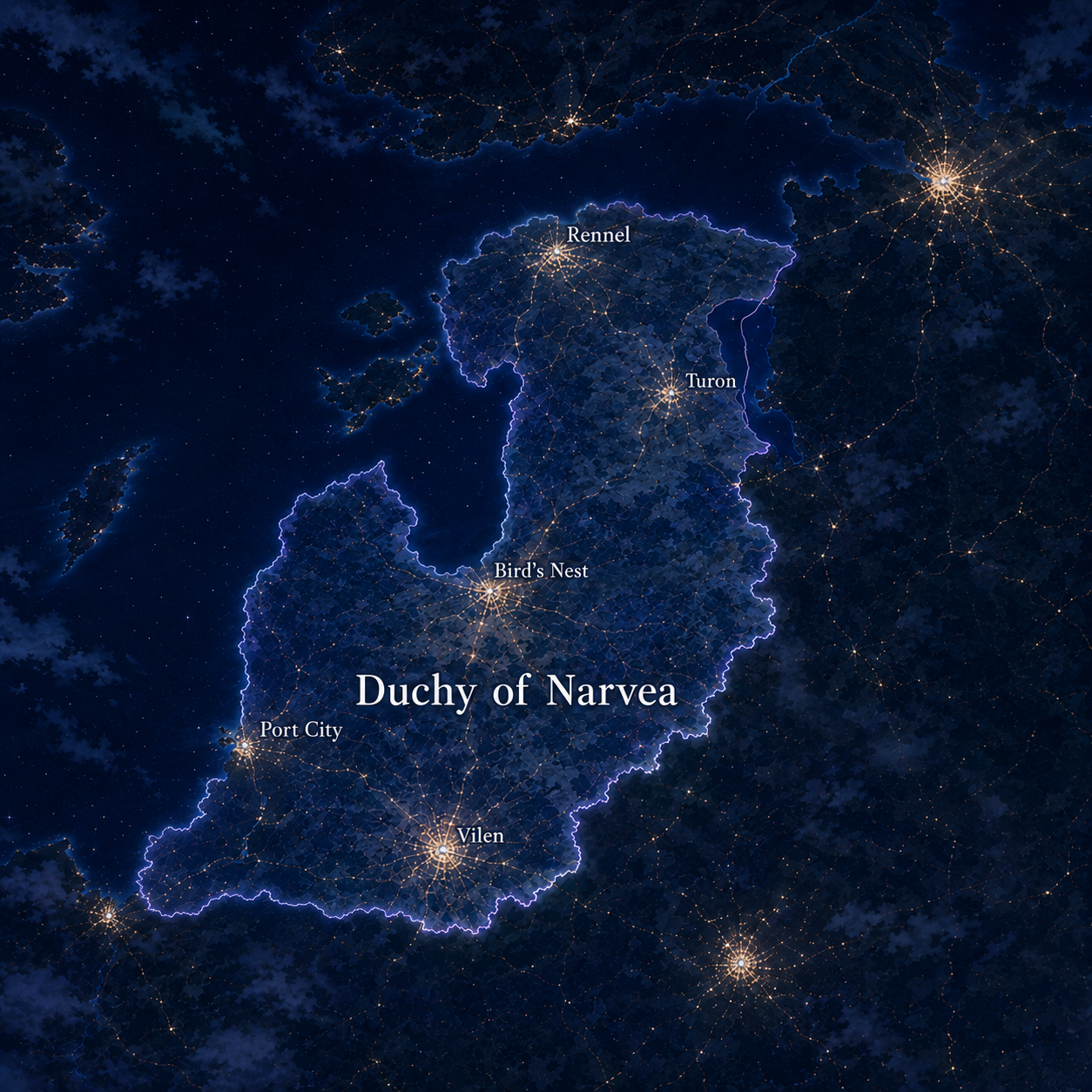
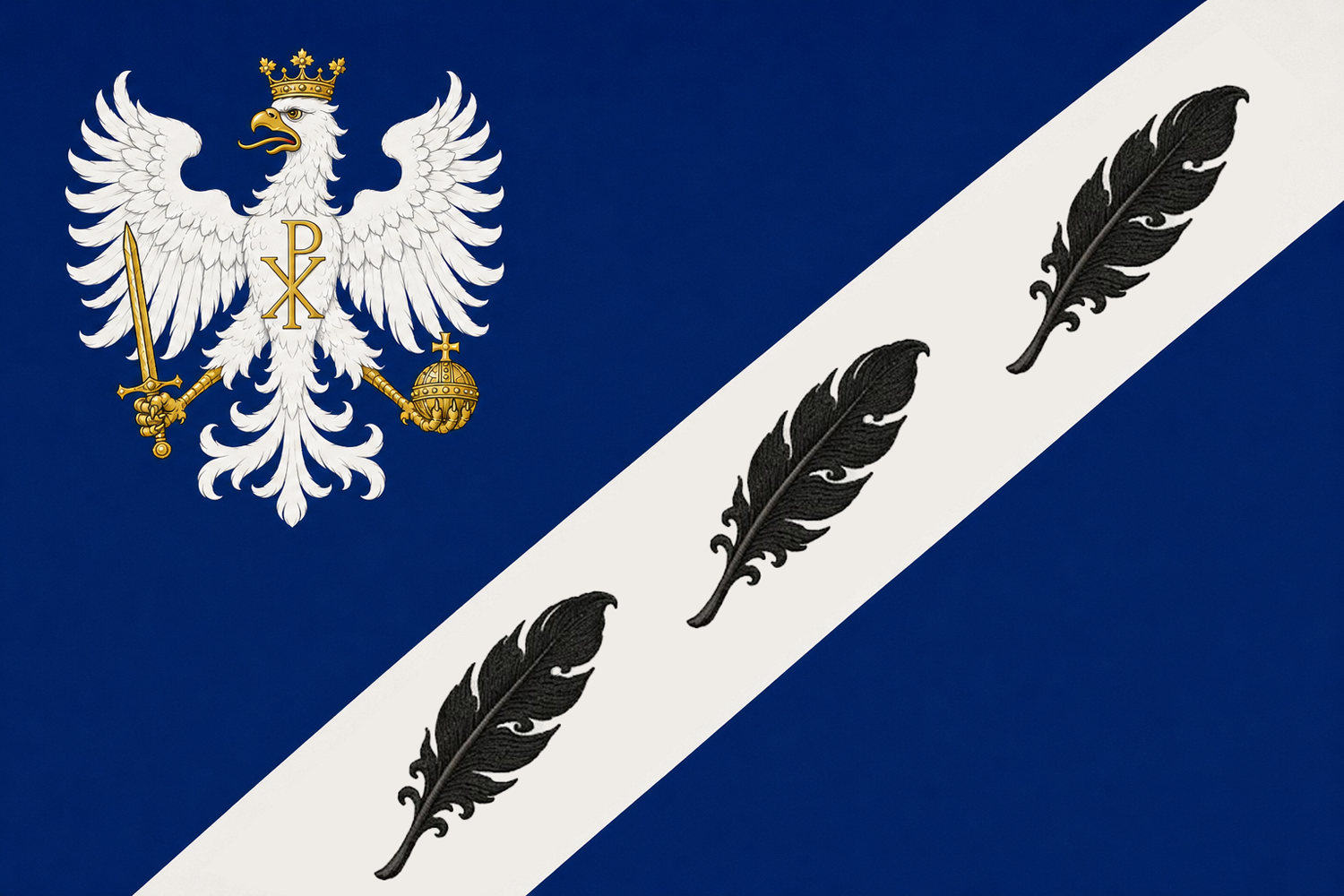
A large, sovereign Baltic country built around two sources of legitimacy: the Ducal Crown and the parliamentary state.
Sovereignty resides jointly in the Crown and the Nation.
Territory
Narvea reaches from the approaches to St. Petersburg toward the southwestern Baltic frontier near Gdansk.
Dual capital tradition
Rennel is the Ducal capital, Vilen the governmental capital, and Turon the military center and home of MSF.
Located in the old Narva region. It represents dynasty, continuity, military tradition, nobility, and ceremony.
Narvea's center of government, law, administration, commerce, and modern political life. Its enormous urban park becomes the first visible center of the disappearances.
Turon is home to the headquarters of MSF, a fully private intelligence business that sells services to the government while retaining control of its own succession and internal affairs. Its officers give the company enough local force to mount a small rebellion or attempt secession if it ever chose to do so. Officer culture, divided logistics, constitutional loyalty, and a genuine lack of separatist ambition keep that possibility theoretical.
No rebellion is openly planned. The possibility simply remains in the backrooms of Narvean political life, where senior officials cannot afford to ignore it.
Constitutional balance
Parliament chooses and controls the government, passes laws, and authorizes public money. The Duke gives constitutional form to those decisions and intervenes only through narrowly defined reserve powers.
Ducal sphere
Head of state and constitutional guardian.
Democratic sphere
Elected authority and the executive accountable to it.
Diplomatic tradition
Narvea became a trusted meeting ground where opposing European powers could settle their differences before rivalry became open conflict.
Its mediation played an important and constructive role during the wars. The settlements of this period also began shaping Narvea's borders into their modern form.
Opposing powers gathered in Narvea and contained an eastern political crisis before it could become a revolution.
Another Narvean conference stopped escalation between European powers, allowing the continent's borders and history to take a different course.
The habit of mediation still shapes how Narvean institutions understand authority, legitimacy, and public service.
People in authority are expected to know several languages, but the custom reaches far beyond diplomatic circles. Narveans often move between languages in ordinary conversation for precision, courtesy, emphasis, or simple habit, even when no negotiation is taking place.
Institutions
Responsibility is divided deliberately. Similar-looking institutions can answer to different centers of authority.
The national Army, Navy, Air Force, reserves, and intelligence services answer through the constitutional government.
National defenceAn elite Crown formation protecting the ducal family, residences, and selected constitutional institutions.
Dynastic securityOrdinary law enforcement remains under civilian authority, most likely through the Ministry of the Interior.
Public orderAdvises the Duke on constitutional questions, appointments, security, foreign affairs, and emergencies.
Sovereign counselA standing bridge between Crown and government for constitutional review, administrative law, major appointments, disputes, and emergency continuity. Its most dangerous cases begin when ordinary state sovereignty collides with supernatural authority the public constitution cannot acknowledge.
Jurisdictional paradoxService and precedence
Narvea maintains its own hierarchy of court and civil ranks. A person's rank controls formal precedence, while their actual work may be diplomatic, judicial, academic, military, or administrative.
He serves as an elite executive troubleshooter attached to a high-ranking personal office. Free from routine administration, he carries delegated authority into confidential criminal investigations, political counter-espionage, emergency corruption audits, and diplomatic errands.
Open Drake's profileCultural character
Narvean is a shared political identity, not a single ethnicity. Different regions keep their own language, faith, architecture, and historical memory.
Regional, linguistic, religious, urban, and rural communities can all be fully Narvean.
Old military customs, ducal administration, civic government, and modern Narvean constitutionalism.
Catholic and Orthodox traditions coexist across different regions.
Baltic merchant culture, old aristocratic ceremony, and modern parliamentary politics.
A modern country that never fully discarded inherited hierarchy.
Why it matters to the story
A crisis in Narvea can become an argument over who has the right to act. The Crown, government, and older institutions must cooperate, but they do not share all their knowledge or accept responsibility for the same consequences.
Weather and visibility
Fog is a recurring national problem, especially in certain areas. It delays journeys, restricts observation, and makes searches harder. Much of it is ordinary weather.
During the Spill
Some Holumn incidents produce unusually dense or extensive fog and mist. Vilen's quarantined park and river encounters are particularly affected. Familiar routes become difficult to follow by sight, and people can lose visual contact while remaining close enough to hear one another.
Fog alone cannot tell a resident whether anything supernatural is happening.
Holumns and the Spill